Lacto-Fermented Fennel
Anethole mellows. Lactic acid builds. The result is better than either alone.
Chad Waldman
Analytical Chemist · April 19, 2026
Prep
15 min
Ferment
5–7 days
Total
5–7 days
Servings
1 quart jar
Salt
2.5% by weight
Fennel is divisive. People who hate licorice won’t go near it. People who love it eat it raw, roasted, braised, or thinly shaved with olive oil and citrus. I am firmly in the second camp, but I’m making the case today that fermentation is the best thing you can do to fennel regardless of which camp you’re in.
The licorice flavor in fennel comes almost entirely from anethole — specifically trans-anethole, a phenylpropanoid that makes up 50–80% of fennel’s essential oil. Anethole is not subtle. Raw fennel hits you with it immediately. But anethole is also labile under acidic conditions. As lactic acid accumulates during fermentation and pH drops toward 3.5, the molecular environment changes and anethole’s perception intensity decreases. The result isn’t licorice-free fennel — it’s fennel where the anise note becomes a background note instead of the headline. Tangy and slightly sweet with an herbal finish.
Anethole’s pharmacological profile is well-documented. A 2025 study in Computers in Biology and Medicine (PMID: 40865267) evaluated anethole’s ability to inhibit oxalate crystallization — outperforming potassium citrate, the standard pharmaceutical intervention for kidney stones — via SIRT1 interactions with binding energies of −12 to −16 kcal/mol in molecular dynamics simulations. A 2024 study in IJMS (PMID: 39125701) showed anethole fully prevented electrophysiological and oxidative stress damage in diabetic peripheral neuropathy in rats, with complete restoration of nerve conduction velocity.
These effects are from the compound in your fennel bulb. You’re not getting pharmaceutical doses from a jar of fermented fennel — but you’re getting a real food source of a compound with documented biological activity.
Fennel ferments beautifully at 2.5% salt. The high water content of the bulb means it participates actively in the brine, contributing mineral salts and natural sugars that feed Lactobacillus. Slice thin, submerge completely, and get out of the way.
Lab Session
Lacto-Fermented Fennel — Full Process
Instructions
 1
1Prep and slice the fennel
Trim the fennel: remove the stalks where they meet the bulb (save the fronds, discard stalks unless you want to add them). Slice the bulb in half lengthwise, then slice crosswise into thin half-moons, about 1/8-inch thick. Thin slicing is important — it increases surface area dramatically, accelerating fermentation and producing a more uniform result. Rough-chop a few tablespoons of fronds to add to the jar. They contribute additional anethole and ferment into something almost herb-like.
Chemist’s note
A mandoline makes a big difference here. Uniform 1/8-inch slices ferment evenly. Thicker slices take longer and can be uneven — crisp on the outside, under-fermented in the center. If you don’t have a mandoline, just be deliberate with the knife. Consistent thickness is the goal.
 2
2Make 2.5% brine by weight
Pack the fennel slices, garlic, fennel seeds, peppercorns, and fronds into the jar. Add 2 cups filtered water. Weigh the full jar and tare to zero, then note the weight. Your salt is 2.5% of that total. For a well-packed quart jar of fennel with 2 cups water, expect 12–16g. Dissolve salt thoroughly in a small amount of warm water first, then pour into the jar. Stir to distribute.
Chemist’s note
Fennel releases a lot of liquid as it ferments — more than most vegetables. This is fine. The cell moisture contributes to the brine and adds flavor compounds. Don’t top off with plain water mid-ferment unless the fennel is no longer submerged. The brine that develops naturally is more complex than what you added at the start.
 3
3Submerge and seal
Fennel floats — not as aggressively as celery, but persistently. Use a fermentation weight, a zip-lock bag filled with brine, or a small jar that fits inside the mouth to keep slices submerged. Press everything down firmly and check that the liquid covers all solids. Leave 1 inch of headspace above the brine for CO2 expansion. Seal with an airlock lid, or a standard lid that you’ll burp daily.
Chemist’s note
Adding the fronds helps — they interlock with the bulb slices and reduce floating. If you’re still having trouble, cut the half-moons smaller so they wedge into the gaps between each other. The goal is a dense, compressed mass that stays below the liquid line without needing constant attention.
 4
4Ferment 5–7 days at 65–72°F
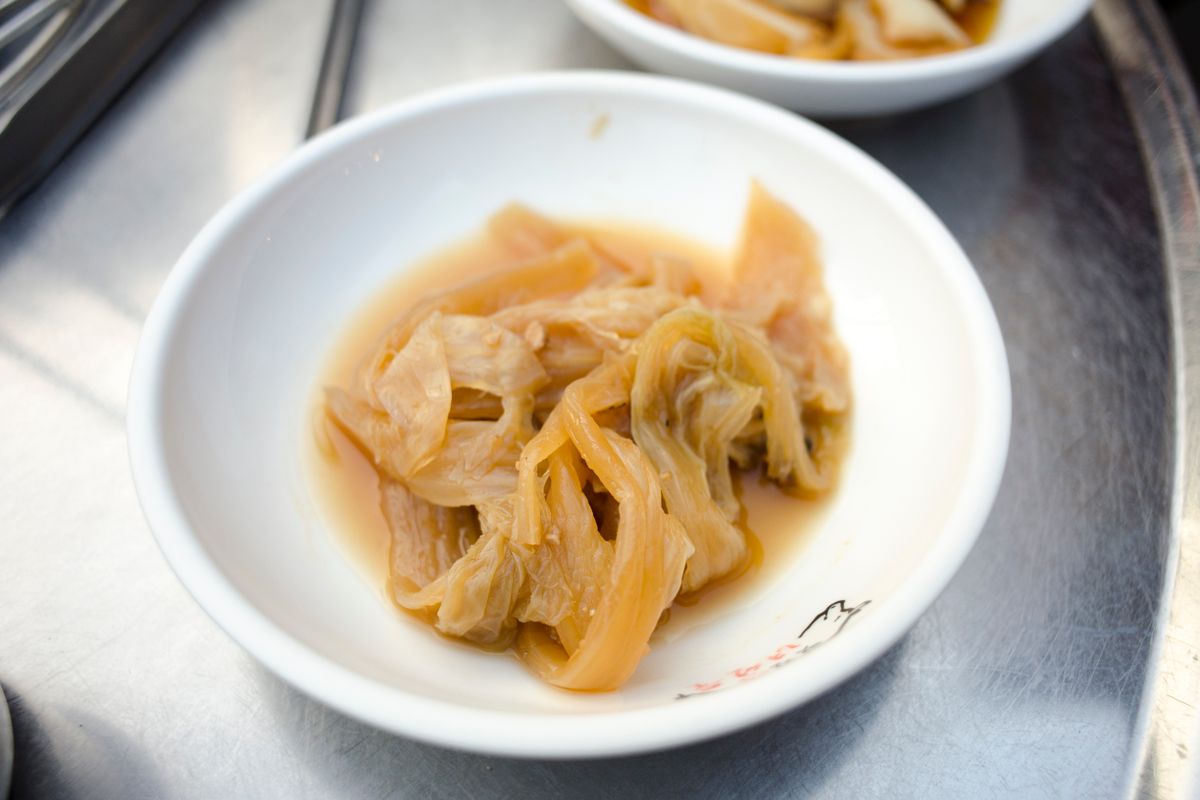
Store at room temperature, out of sunlight. Fermentation is brisk with fennel — you’ll see bubbles within 24 hours and significant brine cloudiness by day 2. The color will shift from white to a pale cream-ivory. The anethole aroma will be present but mellowing. By day 4–5, taste a slice: the anise note should have retreated to background, with lactic tartness in the front and a faint sweetness from the natural fennel sugars. Day 5–7 produces optimal complexity.
Chemist’s note
Fennel ferments faster than daikon or beets because its sugars are more immediately available to Lactobacillus. At 72°F I hit target pH (3.4–3.8) by day 5. At 65°F, day 7. Temperature is the primary dial for speed. Don’t rush it below day 5 — the anethole mellowing process needs time. Day 3 fennel still tastes sharply of licorice, just sour. Day 6 fennel tastes like something you’d pay for.
 5
5Test pH and refrigerate
Test pH starting day 4. Target is 3.4–3.8. The fennel should taste tangy, slightly sweet, and herbal — anise in the background, lactic acid upfront. The brine should be bright and savory. Move to refrigerator when it’s right. Fermented fennel keeps 6–8 weeks refrigerated. Use it alongside fish, in grain bowls, in vinaigrettes, or roughly chopped into yogurt. The brine is excellent in cocktails and makes a strong negroni variation.
Chemist’s note
The fennel fronds transform significantly during fermentation — they soften, lose their grassy rawness, and take on a savory-herbal quality that’s hard to describe but easy to appreciate. Don’t discard them. They’re often the best part of the jar by week 2.
The Science
Anethole inhibited oxalate crystallization more effectively than potassium citrate (the standard pharmaceutical intervention), with molecular dynamics simulations confirming stable SIRT1 binding at −12 to −16 kcal/mol — positioning it as a candidate anti-nephrolithiasis agent.
Comput Biol Med, 2025 · PMID: 40865267 (opens in new tab)→
Anethole fully prevented diabetes-induced electrophysiological alterations in rat sciatic nerve — restoring conduction velocity and reducing oxidative stress markers — demonstrating neuroprotective effects via antioxidant mechanisms.
Int J Mol Sci, 2024 · PMID: 39125701 (opens in new tab)→
Fennel waste extract contained significant chlorogenic acid derivatives (4-caffeoylquinic acid, 3,4-dicaffeoylquinic acid) with antioxidant activity correlated to total phenolic content — the same polyphenol classes preserved and concentrated during lacto-fermentation.
Molecules, 2021 · PMID: 33807371 (opens in new tab)→
Lacto-Fermented Fennel
Anethole mellows. Lactic acid builds. The result is better than either alone.
15 min
Prep
5–7 days
Ferment
pH 3.4–3.8
Target
Ingredients
Equipment
- Wide-mouth quart mason jar
- Kitchen scale (0.1g precision)
- pH meter or pH strips
- Mandoline or sharp knife (thin slicing matters here)
- Fermentation weight
- Airlock lid or standard lid